Summary about the movement of cloud in mid-April
Makoto Adachi
The Association of Lunar and Planetary Observers of Japan(ALPO-Japan)
May 4, 1999
|
It goes into April, and the area where it can be observed in Japan changes with Tharsis and Tempe from Amazonis. The observation of Kansai branch becomes very active, and gets many images of mars.
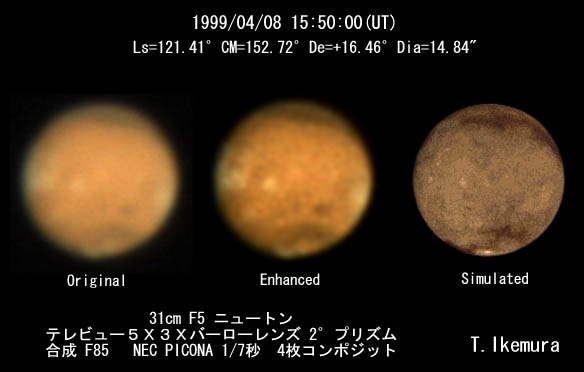
It is that some cloud was observed at east and west in the equatorial zone of mars to pay attention to us in April. Ikemura's image on April 8 (Figure-1) takes the characteristics well as an example. The row of the cloud seen in the east from the center, which is covered the top of Nix Olympica, shows the feature that the cloud covers in the east and west.
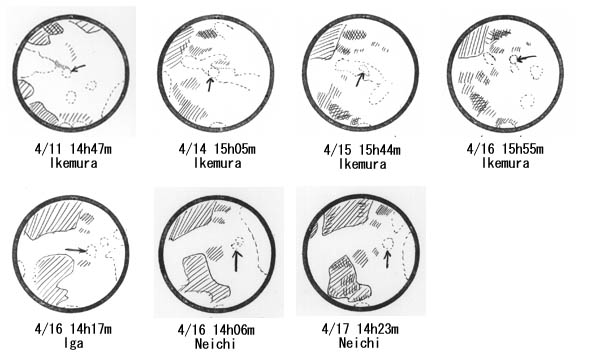
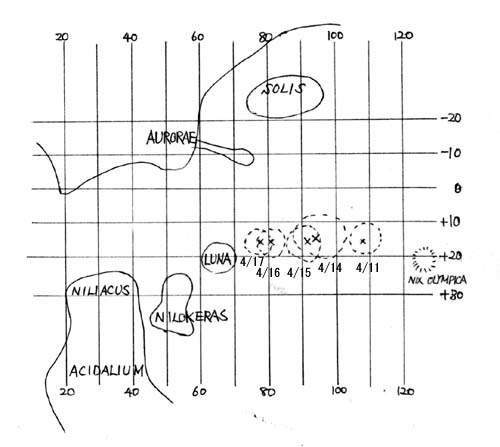
A faint cloud was found at 20 deg.N latitude and 90 deg. longitude for Ikemura's image(15h44mUT) on April 15. Also, a faint cloud was further found at 20 deg.N latitude and 80 deg. longitude for Neich's image on April 16. Tracking was tried to ours images because it noticed that a cloud was moved. As a result, it was found out that a cloud could have been seen since April 11 (Figure-1 shows no cloud on April 8). It seems that a cloud moved from 15 deg.N latitude and 110 deg longitude on April 11 to 15 deg.N latitude and 80 deg. longitude on April 17, and the speed of moving was about 5 deg./day toward east.
In the atmosphere of the earth, the wind of equatorial zone is flowing toward the east from the west. As it leaves the equator, the Coriolis' force is received, and the wind changes flow to the northeast from the northwest at about 15 deg. N latitude. As the mars is a small planet, the atmosphere of this planet shows the large circulation which flow from polar region to the another. It was evidenced that the dark feature of north hemisphere became darken as the north polar cap became small by the ground-based observations. But the large circulation can not apply the moving of a cloud in mid-April. The large yellow cloud, which covered with whole mars in 1973, moved toward east in this latitude region. The cloud in this mid-April moved toward east in same manner of 1973. Although a cloud in the equatorial zone generally moved to the south-north direction in according to the large circulation, the cloud in this mid-April moved toward east from west without the moving of latitude. Therefore, it seems that this cloud flow toward east by the westerly wind, and this phenomenon is not a sand storm but a cloud of upper atmosphere. | |||||||||||||||||||||||||||||||||||||
 ALPO-Japan�@Mars Section