| Ganymede And IO by A.Soares |
C14 f/22 + IR pass 685 Eclipse of Jupiter's Galilean Moons: Geometric and Scientific Aspects (Ganymede) The eclipse of Jupiter's Galilean moons occurs when a satellite passes through the shadow cast by the planet, temporarily ceasing to receive direct sunlight. Unlike transit and occultation phenomena, the apparent disappearance of the moon during an eclipse does not result from the interposition of Jupiter's disk along the observer's line of sight, but rather from the suppression of reflected light due to the satellite entering Jupiter's umbra or penumbra. The geometry of the eclipse is determined by the alignment between the Sun, Jupiter, and the eclipsed moon, being sensitive to the dimensions of the planet's shadow cone and the orbital position of the satellite. The moon's entry into and emergence from Jupiter's shadow do not occur instantaneously, especially during passage through the penumbra, which allows for detailed analysis of the light curves associated with the event. These curves reflect both the distribution of solar illumination and physical properties of the surface and, when present, the moon's extremely thin atmosphere. From an observational point of view, eclipses of the Galilean moons are particularly valuable events for studying the thermal and radiative properties of these bodies. During the eclipse, the absence of sunlight allows for the investigation of surface cooling processes, the rate of which depends on thermal inertia and the composition of the regolith. Near- and mid-infrared observations reveal that some moons may remain detectable during the eclipse, either due to residual thermal emission or due to indirect scattering mechanisms of sunlight in Jovian atmosphere. In the case of Io, eclipses have been used to study rapid brightness variations associated with its intense volcanic activity and the presence of an extremely rarefied atmosphere, composed mainly of sulfur dioxide. The photometric response of the moon during shadow immersion and emergence can provide important constraints on atmospheric density and the spatial distribution of material ejected by volcanic processes. Furthermore, precise timing of the start and end times of eclipses contributes to the refinement of the orbital ephemerides of the Galilean moons. Historically, the systematic analysis of Io's eclipses played a fundamental role in the first observational determination of the finite speed of light, demonstrating the enduring relevance of these events to astronomy and physics. Thus, eclipses of the Galilean moons represent a unique observational tool, combining geometric simplicity with high scientific potential, allowing investigations ranging from orbital dynamics to the thermal and atmospheric properties of these natural satellites.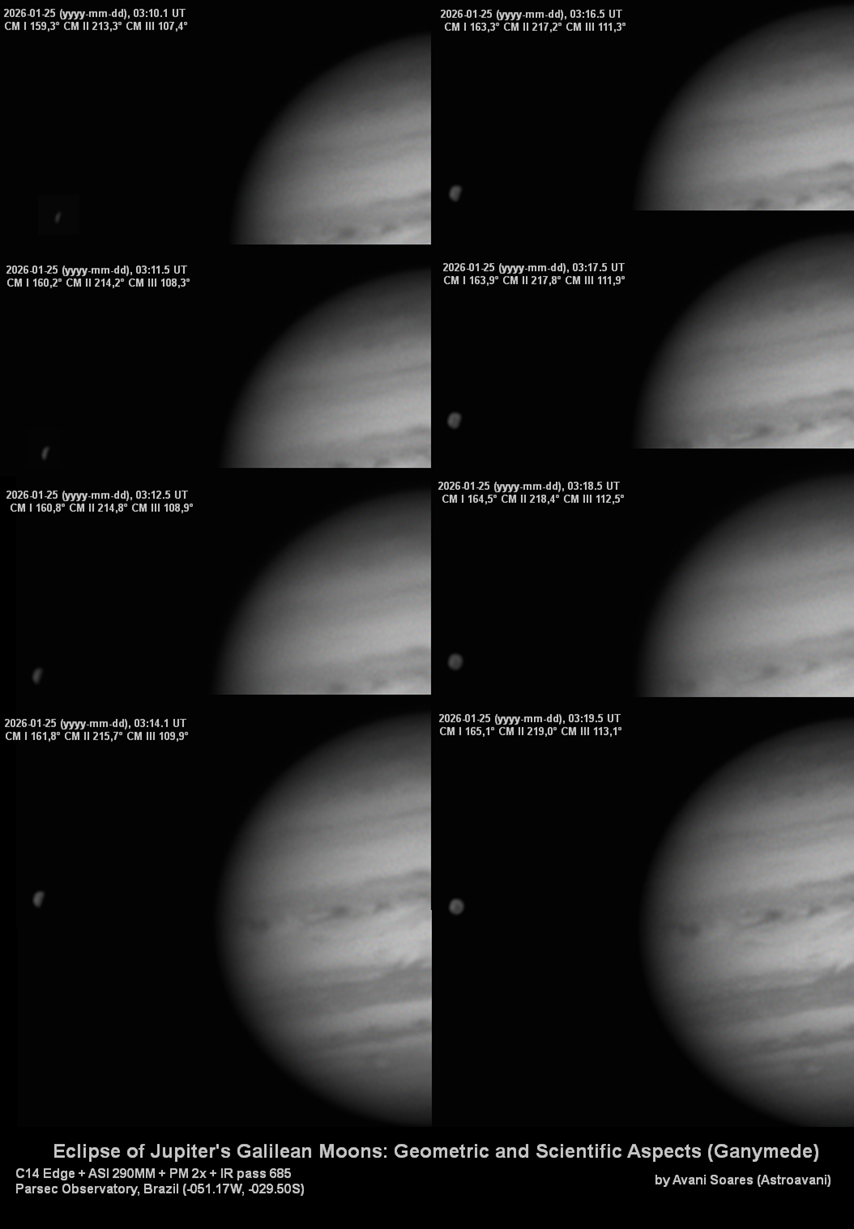
ALPO-Japan Latest